Portland leaders frustrated, say city allowed to set harsher rules for cigarettes than fentanyl
State laws, court orders have hampered Portland’s ability to crack down on drugs and homelessness, leaders say

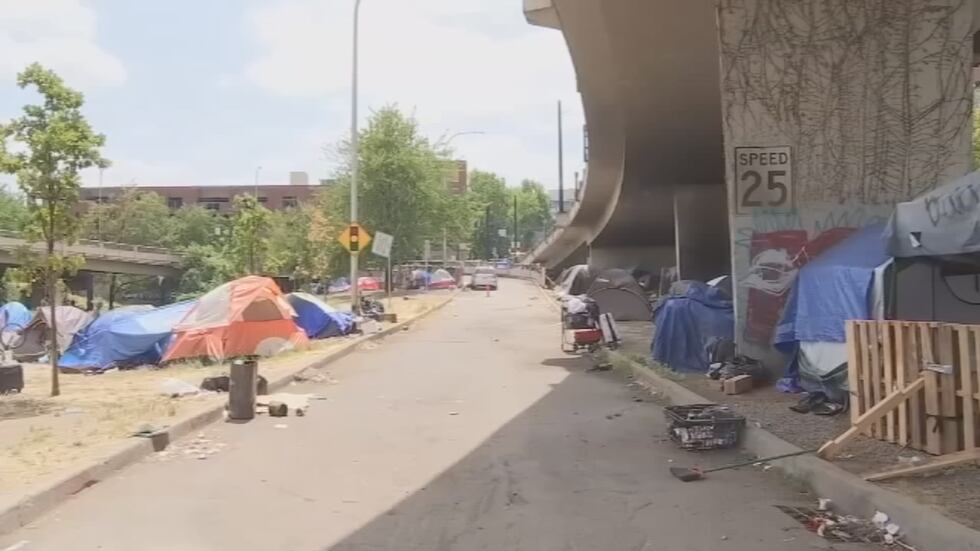
PORTLAND Ore. (KPTV) - When it comes to cleaning up Portland’s streets, local officials claim their hands are tied and are pleading with state lawmakers for help during the next legislative session.
“It is extremely frustrating for us to take the steps that we believe, and, frankly, that we know we need to take as a municipal government to address open drug use or to address addiction or to address unsanctioned, dangerous and squalid camps in our community,” Portland Mayor Ted Wheeler said. “And yet we don’t have all of the tools we need at the municipal level to be able to get done what we need to have done.”
LATEST: Kotek, Vega Pederson, Wheeler declare 90-day State of Emergency for fentanyl in Portland
In the past year, the Portland City Council approved two major ordinances that addressed drug use and homeless camps, but they were quickly met with opposition.
In September, commissioners overwhelmingly adopted an ordinance prohibiting drug use in public places, but they also pointed out that the measure wouldn’t take effect until state legislators passed legislation granting them the authority to enforce it.
“It is insane,” said Commissioner Mingus Mapps, who is running to succeed Wheeler as mayor. “The city of Portland can make rules about where you can smoke a cigarette, but I cannot make any binding rules about where you smoke fentanyl. That is part of the reason why Portland looks the way it does, and that needs to change.”

An ordinance banning anyone from using tents to obstruct sidewalks or businesses in Portland between the hours of 8 a.m. and 8 p.m. was also passed by the council in June. However, a circuit court judge stopped the city from enforcing the prohibition when the Oregon Law Center filed a lawsuit, claiming the limitations violated both the state constitution and existing statutes.
“We’re going to end up winning this challenge,” Commissioner Dan Ryan said. “Because the fact is, we need to provide services for people who are on the streets during the day, and we need to free up our public right of way.”
Beginning on February 5, Oregon legislators will convene for a brief legislative session. Restructuring Measure 110, the voter-approved measure that decriminalized the possession of tiny amounts of drugs, is probably going to be their top priority.
Currently, the state classifies drug possession as a Class E violation. Police can issue citations to violators for $100, but if the suspect phones a hotline and completes a treatment assessment, the fine will be dropped. Overdoses and open-air drug use have increased in places like Portland, yet almost no one pays the fine or calls the hotline.
Both Mapps and Ryan called reform a “common sense” move.
“Oregonians are not happy with how [Measure 110 has] been implemented,” Ryan said. “It’s our job as legislators and public servants to listen to that and admit that we have to roll it out with some improvement.”
The Democrat-controlled Joint Committee on Addiction and Community Safety Response has suggested classifying drug possession as a Class C misdemeanor, the lowest felony category in the state, with a maximum sentence of 30 days in jail, a maximum fine of $1,250, or both.
Republicans in Oregon want to classify possession of drugs such as heroin, fentanyl, and meth as a Class A misdemeanor and demand treatment in order to be released from jail. Under their plan, convicted drug users could punished with up to a year in prison, a $6,250 fine, or both.
When the short session starts next month, lawmakers will have just 35 days to reach a consensus.
Wheeler said he needs Oregon Gov. Tina Kotek, the legislature and county government to work with the city, even if that means changing their views on homeless camp sweeps and drug policy.
“If they really want to see this community improve the way it needs to improve, they need to get into line with what this city council is doing,” he said. “We’re unified as a city council … but if the courts and the legislature, and other political players in this state who hold sway over what we do continue to block us, it makes our job all that much harder.”
“We’ll work around them. We’ll find other solutions,” he added. “But it would be great if we could all get on the same page.”

Wheeler has overseen some of the most challenging years in Portland’s recent past. The coronavirus pandemic caused the city to incur enormous economic losses, and over four years later, foot traffic in the downtown area has still not entirely recovered.
After George Floyd’s death in Minneapolis, Portland was overrun by violent protests and riots for almost 100 nights in a row. Homelessness kept rising, homicides reached a record level, and drug usage in public increased in frequency.
The mayor said he was “happy to say we’re making really good progress” on public safety and livability issues. Homicides and shootings dropped dramatically last year. Assaults and car thefts also decreased in 2023, according to Portland Police Bureau data.
“We’ve hired more police officers, we’ve expanded patrols, we’ve put foot patrols back into the central city,” Wheeler said.
And while PPB continues to suffer from staffing shortages, the city council has “funded private sector security in particular hot spots,” according to the mayor.
------
Hannah Ray Lambert and Fox Digital contributed to this report.
Copyright 2024 KPTV-KPDX. All rights reserved.